

Insights into educational systems around the world
In its April 2025 issue, the Revue International d'éducation de Sèvres publishes an article by Elisabeth Plé (Université of Reimes Champagnes-Ardenne) dedicated to the initiative La main à la pâte. Through this text, it is a whole section of the history of the renovation of science education that is retraced, form the first experiments launched in 1995 to the international influence of the approach. Here is a translation:
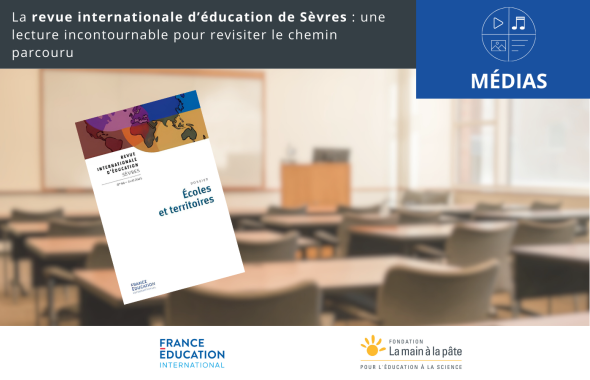
This paper has been written in French by Elisabeth Plé in Revue internationale de Sèvres, n°98 (april 2025).
La main à la pâte: revitalizing science education worldwide
In 1995, Georges Charpak, together with fellow members of the French Academy of Sciences Pierre Léna and Yves Quéré, launched La main à la pâte (LAMAP). Charpak, himself the son of Polish immigrants, arrived in France at age seven, often expressed the debt he felt toward the “school of the Republic,” which, he believed, had made him who he became. Crowned with the Nobel Prize in Physics (1992), yet dismayed to learn that natural sciences were scarcely practiced in primary schools, he devoted his energy, his renown, and his convictions to developing this initiative with the support of the Academy of Sciences.
Initially inspired by Hands On, a project led by nobelist Leon Lederman in disadvantaged neighborhoods of Chicago, La main à la pâte quickly gained autonomy: it developed its own resources, created a website, and drew on the practices of leading teachers engaged daily in inquiry-based classroom work.
To frame this recommended approach, centred on active pupils who build knowledge through exploration, experimentation, inquiry, and argumentation, a ten-principle charter was drafted. It affirms that science should contribute to children’s education from nursery school onward: science as a school of objectivity and universality, a means to cultivate reasoning and argumentation. In a laboratory-like spirit, young pupils keep a “notebook of experiments,” written in their own words. Another goal is to demystify science for teachers by bringing them closer to authentic scientific practice. Teacher support is paramount: resources must be readily accessible, particularly through the website, and teachers may receive in-class support from scientists or university students.
Initially considered an experiment, La main à la pâte rapidly won the backing of the Ministry of National Education. In 2000, the Ministry launched a Plan for the Renovation of Science and Technology Teaching at School, explicitly referring to LAMAP, described as a “fortunate initiative of Georges Charpak and the Academy of Sciences.” The 2002 primary-school curriculum drew on the plan’s recommendations and introduced what became known as the inquiry-based approach. Special attention was devoted to pupils in disadvantaged neighborhoods and pupils with disabilities.
Independent yet closely linked to the Ministry, serving teachers while nourished and supported by the scientific community, this profoundly humanistic movement gradually structured itself with the unwavering backing of the Academy of Sciences. Since 2011, it has been carried by the La main à la pâte Scientific Cooperation Foundation and has led to the creation of eleven Maisons pour la science—university-based hubs fostering dialogue between teachers and scientists across France.
The first two decades of La main à la pâte's international action
In the early 2000s, an extensive international undertaking began, ultimately enriching Lamap in return.
At the dawn of the 21st century, several countries observed the same issues as France: almost no hands-on science teaching in primary schools; science instruction largely restricted to textbooks; declining interest in science careers—especially among girls; and an urgent need to modernize educational systems. At the same time, a global reflection was emerging around inductive approaches intended to make science education more appealing. In North America, an inquiry tradition inspired by Dewey and Bruner had given rise to Inquiry-Based Science Education (IBSE), complete with standards. From 2006 onward, the OECD’s PISA survey included natural sciences among its three tested domains for 15-year-olds.
Within this context, the InterAcademy Partnership (IAP), presided over by Yves Quéré (2000–2006), together with the IAP Science Education Programme, chaired by Jorge Allende and later Pierre Léna, served as powerful vehicles for disseminating inquiry-based approaches worldwide. The philosophy, methods, and tools developed by La main à la pâte were widely relayed. Numerous meetings, seminars, and conferences—supported by the French Ministry of Foreign Affairs—enabled exchanges on challenges and practices, fostering a shared vision that could be adapted to local specificities.
European projects
Across Europe, ambitious projects led by LAMAP emerged. SciencEduc (2004–2006) brought together five countries, while Pollen (2006–2009) united twelve European cities. Their aims were to compare methods and actions in science-education reform across EU countries, share good practices, and raise European awareness of the stakes involved in science education. Pollen, in particular, was praised (Rocard et al., 2007) for empowering teachers (providing free documentation, practice-sharing networks, strong links with scientists and parents) and for sparking pupils’ interest in science and technology.
New projects sought to involve university training institutions to disseminate inquiry-based science education (IBSE). Fibonacci (2010–2013) brought together sixty higher education institutions, 2,500 teachers, and 45,000 primary and lower-secondary pupils from twenty-five European countries. L’Europe des découvertes invited pupils aged 8 to 14 to contribute to a library of Europe’s great scientific discoveries.
Some of these projects have, by 2025, evolved into well-established structures such as Ruka u Testu in Serbia and Haus der kleinen Forscher in Germany.
Diffusion of LAMAP's resources
La main à la pâte never imposed a standardised program. It offered adaptable resources, enabling partners to align them with their cultural, institutional, and pedagogical contexts, creating mutually enriching hybridizations. The LAMAP website gave rise to mirror sites in German, Spanish, Portuguese, Chinese, Serbian, and Arabic.
Several classroom-video resources, co-produced with the French Ministry of Education, have been subtitled in numerous languages (such as the DVDs Learning Science and Technology at School and Exploring the World in Nursery School), along with the thematic resources developed, published, and translated by La main à la pâte.
Building a global structure for science-education renewal
After initial contacts—often involving foreign delegations hosted by the Academy of Sciences and exploratory field missions—partners worldwide were drawn to Lamap’s realistic yet ambitious approach to science-education reform. Agreements were signed, leading to numerous training missions involving French university trainers, pilot-center staff, and the Maisons pour la science. By 2013, no fewer than eighteen countries had established formal partnerships with La main à la pâte, with several others cooperating occasionally.
Each partnership unfolded differently
China discovered La main à la pâte in 1999 during discussions within the ICSU’s Capacity Building Committee, which involved Vice-Minister of Education Mme Wei Yu. A Chinese programme, Learning by doing, launched in 2000 across four major cities, relied initially on Lamap resources translated into Chinese and later produced a reciprocal document, The Five Cases, translated into French. By 2004, more than 1,000 classes across 200 schools in eleven provinces were involved. Annual seminars alternated between China and France. The collaboration ended after political shifts in China post-2011.
Afghanistan (2002–2006) saw Lamap’s involvement under daunting conditions after decades of conflict. A Priority Solidarity Fund supported teacher training and the creation of Dari-language resources. A National Science Center was subsequently established. Political developments in recent years have likely undermined the project’s long-term ambitions, especially for girls.
Haiti, following the devastating 2010 earthquake, developed a still-ongoing cooperation built on digital tools and joint Franco-Haitian training teams.
In Southeast Asia, LAMAP inspired a regional network through the RECSAM center in Malaysia. Cambodia integrated Lamap within Franco-Khmer bilingual classes before expanding nationwide. Vietnam launched major reforms influenced by LAMAP between 2002 and 2014, culminating in nationwide experimentation and the creation of an inquiry-based pilot center in Quy Nhon.
Latin America remains particularly active in 2025
Colombia’s Pequeños Científicos (1998), rooted in Charpak’s conference at Universidad de los Andes, became a major initiative supported by both the ministry and Colombia’s Academy of Sciences.
Brazil’s Mão na massa, initially piloted in São Paulo after a study visit to France, spread rapidly nationwide and has since become autonomous while retaining strong ties with France and other Latin American countries.
Mexico developed the influential programme La Ciencia en tu Escuela through its Academy of Sciences, later linked to the Innovec initiative and extensive Franco-Mexican exchanges.
Chile’s ECBI programme (2003), inspired jointly by Lamap, the US National Science Resources Center, and Innovec, expanded through the Ministry of Education and universities. It later integrated psychosocial components after the 2010 earthquake. In 2015, it evolved into the ICEC programme, now embedded in university-based teacher training.
Strong links established among Latin American countries and the engagement of the Siemens Foundation fostered a major regional network for innovation in science education, from which Lamap has greatly benefited.
International Seminar
Responding to a growing demand for exchanges, a yearly international seminar has been held in France since 2010 with support from the Ministry of Higher Education and Research. Between 2010 and 2018, it introduced methods and tools to trainers from outside the EU. More than 450 participants from eighty countries subsequently developed initiatives in their own contexts. Since 2019, the seminar has focused on Francophone African countries.
Refocusing on the African continent
Since 2015, La main à la pâte has prioritized developing countries, particularly in Africa, aligning its work with French educational-cooperation actors and local ministries.
Notable initiatives include:
- Mali (2015–2022): a health- and science-education programme supported by Fondation Mérieux.
- Sudan: contributions to initial and continuing teacher training for inquiry-based science.
- Madagascar (Aquem, 2017–2020) and Senegal (Adem-Dakar, Paebca, 2017–2019): teacher-training projects supported by the AFD.
- Morocco: emerging cooperation via AEFE.
- South Africa: new collaborations via French embassies.
- Comoros (Bundo la Malezi, 2024– ): strengthening of science education in lower secondary schools, support for curriculum writing, and creation of school science gardens.
Current issues
Supported by the Academy of Sciences, La main à la pâte has evolved over its thirty-year history, enriched by its international engagements. Yet in some countries, inquiry-based science education is no longer a priority; emerging countries often consider their teachers sufficiently trained, whereas in South America these approaches remain highly relevant, increasingly intertwined with issues such as climate change, interdisciplinarity, and local social concerns (e.g., social cohesion in Chile).
In 2025, Lamap’s international partnerships concentrate on African countries, where training teachers in inquiry-based science represents a springboard for system-wide reform—thus echoing Yves Quéré’s idea of “science as teacher.”
Recent criticisms arose from hasty interpretations of PISA 2015 suggesting that “greater exposure to inquiry-based instruction correlates with lower science scores in 56 countries.” Sjøberg (2015) highlighted the normative character of PISA, questioning its alignment with locally meaningful science education.
Pierre Léna (2018) argued that covering an entire curriculum exclusively through inquiry would be counterproductive. Effective teaching requires a composite approach blending explicit instruction and investigative moments—moments that PISA results also show to be crucial for fostering scientific interest, epistemic references, and even scientific vocations.
Finally, Lamap has always emphasized the need for teachers to guide and support pupils' inquiry—a need that requires sustained, long-term training enabling teachers to become genuine experts in inquiry and to share with pupils the pleasure of engaging with science. For thirty years, La main à la pâte has extended its hand to countries worldwide with this aspiration in mind.
Our latest news
Découvrez L@map, la plateforme de formation en ligne pour les professeurs du premier degré et du collège.